
AI is often discussed as if it were exclusively about speed, power, stock valuations and the next benchmark. Which model is the smartest? Which party has the most chips? Who owns the infrastructure?
Those are important questions. But for me, it starts somewhere else.
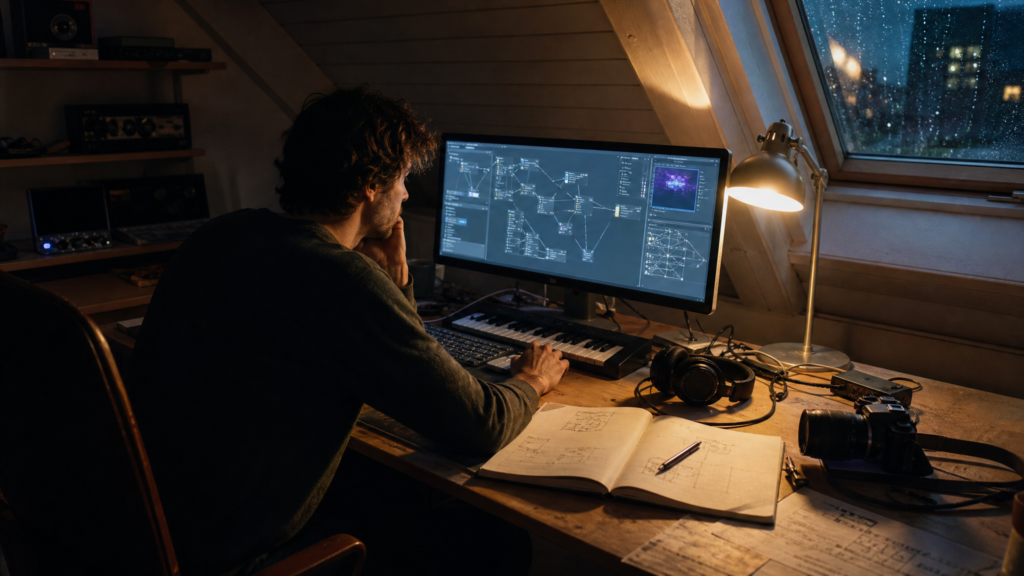
For me, it starts with the kid in the attic. Someone with an idea, a computer, music in their head and the need to create something that didn't exist yet. Not because it has to generate revenue straight away. Not because it has to dominate the world. But because the process itself is enjoyable: researching, trying, making mistakes, rebuilding and eventually seeing how separate pieces suddenly come together as one.
That feeling is the driving force behind Play A Note, Video Editor 4.0 and the development of my own local AI environment.
A long road of combining
The combination of technology, music and creativity is not a new identity I adopted because AI is now popular. It is the thread that has run through my life for much longer.
Computers, music, software, visuals, ideas, experiments and building solutions that don't exist off the shelf: it always ran together. Sometimes that became a music production. Sometimes a website, application or technical solution through my development work. Sometimes a video, a visual concept or a combination of camera, greenscreen, sound and editing.
When machine learning became more accessible and the first large chat models appeared, more and more of those separate worlds began to converge. Not all at once, and certainly not without effort. But a new flow emerged: a way to not only conceive ideas, but also take them further technically.
The past two years have therefore not been a straight road towards a single end product. They were years of research, testing, building hardware, writing software, comparing models, optimising workflows and above all: trial and error.
You don't build a local studio at the push of a button
From the outside, generative AI can seem simple. You type a prompt, press a button and an image appears. But anyone who wants to go beyond a single, accidental clip quickly discovers how much is happening beneath the surface.
For consistent characters, usable footage, a personal style, control over the process, good audio, editing, VFX corrections and a story that lasts longer than a few seconds, you need more than one online tool. You need a workflow. Hardware. Storage. Computing power. Knowledge of models. Custom software. And above all, a great deal of patience.
Video Editor 4.0 grew out of that practice: as an independent, local creative production environment in which music, image, AI, camera work, greenscreen, VFX and editing complement one another.
Not to automate human creativity away, but to give it more room to play.
The digital colleague: smart, helpful and sometimes stubborn
An important part of that development is working with an agent and LLMs: a digital companion that can think along, structure, research, help write code and support processes.
But that too is no magic shortcut.
An agent doesn't automatically become smart in exactly your way of working. You build context step by step. You test. You discover where an approach falls short. You rewrite instructions. You make a workflow smaller, clearer or simply smarter. Sometimes an experiment yields results in ten minutes. Sometimes you spend days on a problem whose solution turns out to be surprisingly simple.
That isn't frustrating because it fails; that is the creative and technical process. A studio, instrument or system doesn't become good because everything works immediately. It becomes good because you learn to listen to what goes wrong.
A digital colleague also needs guidance. Not as a replacement for the maker, but as an extension of their workbench.
The new barrier: not the idea, but access
In an earlier article on UtileWebsites I wrote about the great AI shift: the battle is no longer solely about which model is the smartest, but increasingly about who can actually deliver the required computing power.
That has direct consequences for independent makers and developers.
The hardware required for serious local AI workflows is expensive. Not just the GPU itself, but everything around it: system memory, storage, cooling, power consumption, maintenance and the time needed to get everything running stably. Those who opt for cloud solutions avoid part of that investment, but face recurring costs, credits, limitations, changing terms and dependency on external platforms.
It was precisely the affordability of earlier AI steps that made it possible to build gradually: first experiment, then improve one component, then test a new model and slowly shape your own environment. That room to manoeuvre comes under pressure when access to computing power becomes increasingly expensive, scarce or tightly controlled.
That is a shame, because innovation doesn't only emerge in large companies with enormous data centres. Innovation also emerges with independent makers who have an unusual idea, can't let it go and are willing to tinker with it for months or years.
Open models keep the door ajar
That is why developments around new, more accessible models matter. Not because any one region, company or model has all the answers, but because a healthy creative and technical landscape requires choice.
Developments around models from DeepSeek and Kimi, among others, show that the market does not have to be dictated entirely by one closed ecosystem. More competition, more efficient models and accessible alternatives can give breathing room to developers, small studios, researchers and makers who want to keep experimenting.
That in no way undermines my admiration for American models, researchers and hardware innovation. On the contrary: the technical achievements of parties such as OpenAI, Google, Anthropic and NVIDIA are impressive and have made much of this development possible.
But admiration does not mean that dependency is always healthy.
When access to creativity, research and development is determined primarily by who can pay the highest price, the playing field shrinks. AI then risks transforming from a new creative tool into a closed toll road.
Technology is not an end goal
Of course there are economic interests. Of course AI is geopolitical. Compute chips, energy, data, models and infrastructure are part of power and money. That is the reality.
But for a maker, there is another reality.
The desire to build something. The joy of an unexpected solution. The first time an idea actually works. A melody that suddenly falls perfectly beneath exactly the right image. A character that remains believable throughout a video. A technical system that, after dozens of failed attempts, finally does what you had in mind.
There is something childlike in that, in the best sense of the word: curiosity without cynicism. Playing because playing has value. Making because making moves you.
More possessions, more servers, more models or more money do not automatically mean more happiness. Technology only becomes valuable when it creates space for human imagination, connection and expression.
From experiment to story
Productions within Play A Note are growing slowly. Where short experiments were once the starting point, productions are now emerging that can sustain several minutes: with music, structure, atmosphere, editing and a visual world of their own.
The next challenge is not to produce as much content as possible. It is to make larger stories possible. A first mini-film is not an endpoint, but it is a meaningful next step: a work in which the technology does not demand attention, but is entirely in service of the story.
That is ultimately the purpose of my own "Hollywood in a Box". Not a factory for quick images. Not a machine that replaces the human. But an independent creative workshop in which one idea can grow into music, image, story and a complete audiovisual production.
The soul writes. Technology is the pen.
28 July 2026 playanote
